
In the early 1980s, Pittsburgh’s rising prominence as a major international medical center drew critically ill patients from around the world. Dr. Thomas Starzl, known as “the father of modern transplantation,” had been recruited to the University Health Center of Pittsburgh (UHCP), which quickly became the international organ transplant destination. Hundreds of patients and families from across the country and around the world flocked to Pittsburgh with the hope of receiving a new organ and a longer life.
Under conditions of maximum stress, family members often facing the loss of two incomes had to improvise living arrangements at costly hotels or apartments, sometimes sleeping in hospital waiting rooms or their cars. Research shows that without access to a safe place close to their medical center, a patient is more likely to experience poorer health outcomes and higher rates of readmission and mortality.
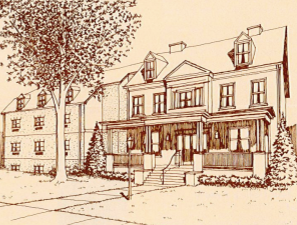
In July of 1981, the opportunity to create a healthcare hospitality house in Pittsburgh presented itself to Joel Ettinger, Executive Vice President of UHCP, through two adjacent homes on McKee Place in Central Oakland. The buildings were for sale, and despite their state of abandonment and disrepair, Joel knew they would become Family House.
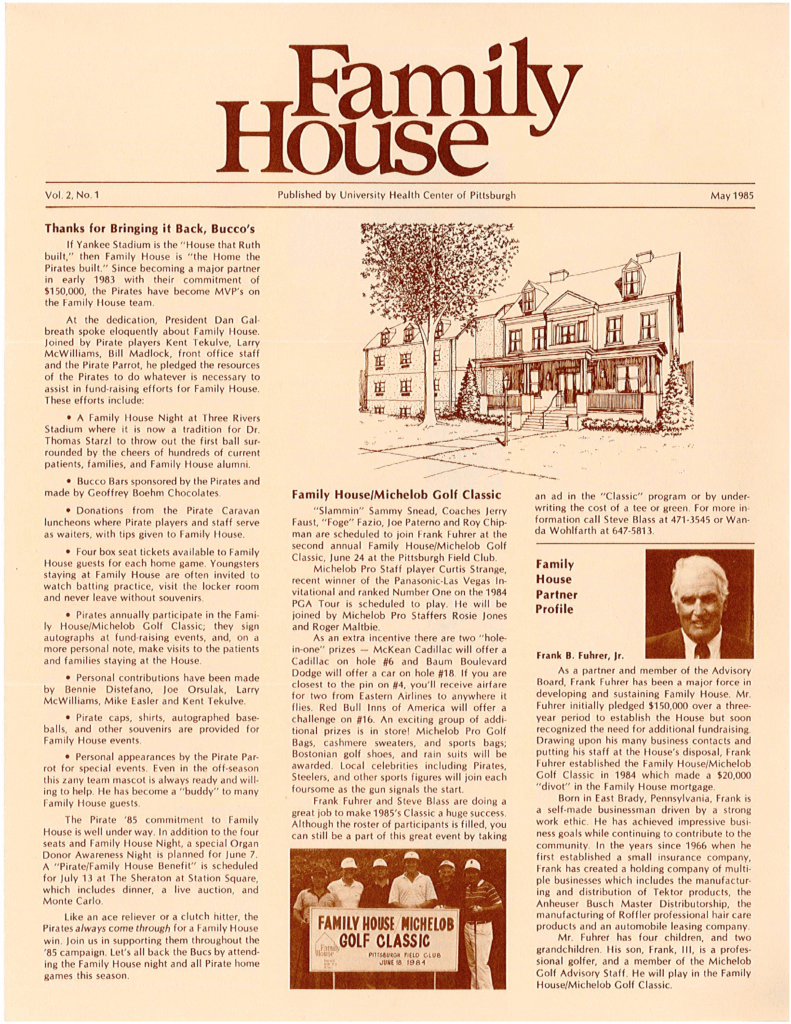
Mary Lou McLaughlin, Chair of the Women’s Auxiliary of the American Cancer Society patient and family housing program, joined UHCP to rally healthcare leaders, charitable foundations, businesses, and hundreds of volunteers to redesign and convert the two vacated fraternity houses into a model healthcare hospitality house. The initial lead gift from the Richard King Mellon Foundation was followed by other key donations from the Pittsburgh Pirates, Frank Fuhrer, Jr., and many others.
On September 27, 1983, Joel Ettinger and Mary Lou McLaughlin, Family House’s first Executive Director, dedicated Family House at McKee Place. Two years later, Family House became an independent 501(c)3 charitable organization. Among the handful of Family House founders was Howard “Hoddy” Hanna III. The Pittsburgh-based realtor and community leader helped identify and acquire Family House’s second property on Neville Street.
Family House Neville opened in 1989, offering 40 additional guest rooms in a restored Pittsburgh mansion. With the encouragement of Dr. Bartley Griffith, a heart transplant surgeon and Family House Board member, Family House Neville became the world’s first out-of-hospital site to welcome a patient surviving off a Novacor heart assist machine while awaiting a heart transplant.
To meet the demand for affordable lodging in close proximity to Pittsburgh’s hospitals, Family House continuously sought additional spaces. In 1991, Family House opened a third home, The Family House Inn, with 47 rooms in a converted office building. In 1997, when that space was no longer available, Family House temporarily readied a floor in Montefiore Hospital until 2001. That same year, Family House Shadyside opened its doors with 44 beautiful suites to comfortably accommodate families.
As the need for affordable lodging continued to increase, Family House sought locations within the heart of Pittsburgh’s academic medical center campus, now UPMC. In June 2009, the top four floors of the University Club were converted into 43 guest rooms, with the racquet ball court and locker room transformed into Family House University Place’s main lobby, kitchen, dining, and living areas. In total, Family House’s four sites had grown to provide 144 low-cost rooms with shared kitchens, libraries, fitness rooms, and more.
In December 2019, the Family House Board voted unanimously to consolidate its remaining “houses” into two locations, yet as it began moving forward with plans to create a two-house, 121-room operation to meet the organization’s long-term needs, word came that the Shadyside Courtyard by Marriott was for sale. This unexpected opportunity presented Family House with the option to consolidate not only its guest accommodations but its administrative offices into a single location. On July 15, 2022, Family House opened its doors and welcomed its first guests to its future and forever “home away from home.”
The complete story of Family House was and remains today the human story – one of compassion, insight, determination, and generosity. The founders of Family House understood intuitively what later medical studies would confirm: critically ill patients who are surrounded by calm, comfortable families enjoy a better quality of life and have a more positive attitude toward their treatment than those without such support. The quality of life that guests enjoy at Family House is more than a nicety; it is a necessity in the treatment process itself.
“Pittsburgh did it right,” said William J. Copeland, retired Vice Chairman of the former Pittsburgh National Bank and Family House’s first Board Chair. “We could have raised the money and put people up in a hotel – other cities have done that. But we followed our hearts and created the right organization.”