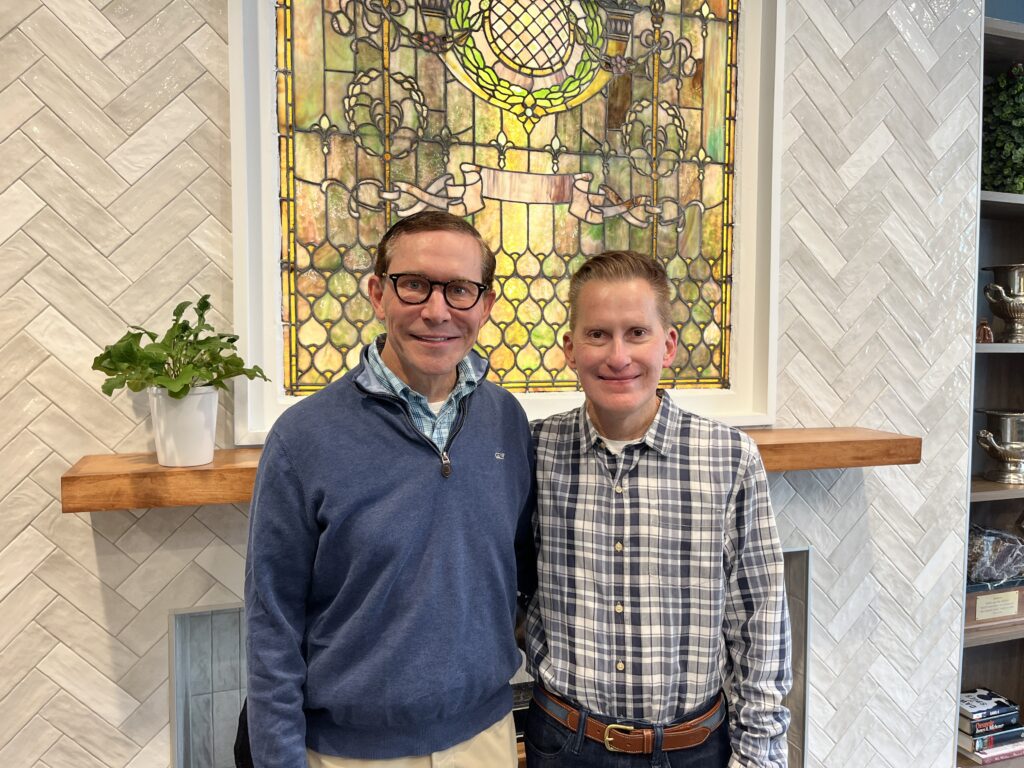
When Carey Rutigliano arrived in Pittsburgh from Tucson, Arizona, he knew his life was about to revolve around hospital hallways and long waits for medical updates. What he didn’t expect was to find a place that felt less like temporary lodging and more like home. That place was Family House.
Carey prefers the term care partner—not caregiver—when describing his role alongside his husband, Scott Nance. “Partner just feels right,” he explains. “I’m not just helping him physically. I’m advocating, coordinating, supporting, and being there emotionally for him.”
That partnership has been tested over the past several years as Scott’s health steadily declined, leading them to Pittsburgh and a life-saving double lung transplant.
Scott’s health journey began quietly around 2022. A lifelong nonsmoker and avid exerciser, he started experiencing increasing difficulty breathing. At first, doctors believed it was exercise-induced asthma. Inhalers were prescribed, but nothing helped.
While living in San Francisco, Scott sought care at UCSF School of Medicine, where specialists diagnosed him with pulmonary fibrosis, a progressive disease that scars the lungs and makes breathing increasingly difficult.
As the disease progressed, Scott and Carey found themselves traveling constantly between medical centers, including the Mayo Clinic in Arizona and Minnesota and eventually to UPMC Presbyterian in Pittsburgh. Each visit brought more testing, more evaluations, and harder truths.
Everything changed during a flight home from Pittsburgh last year. Scott’s oxygen levels plummeted mid-flight, forcing an unexpected ICU stay at UC Hospital in Denver. COVID had severely exacerbated his condition. From that moment on, supplemental oxygen became a permanent part of Scott’s life. And a lung transplant became urgent rather than eventual.
Choosing Pittsburgh and Family House
Scott was listed for transplant at both Mayo Clinic and UPMC Presbyterian. While both offered world-class medical care, the decision to proceed in Pittsburgh came down to more than medicine.
“It wasn’t just about the surgery,” Carey says. “It was about everything that happens around it, especially for the care-partner waiting.”
Carey is deeply social and candidly admits he needed more than a quiet room while Scott was hospitalized. During earlier visits, he and Scott stayed at Family House, and the difference was immediate.
“Every time we came back to Family House, we both felt it,” he says. “It’s warm. It’s welcoming. You don’t feel alone here.”
During his stays, Carey leaned into everything Family House offers. He started each morning with the Daily Healthy Breakfast Program before heading to the hospital. He made time to use the fitness room, something he hadn’t consistently done at home, and relied on the complimentary shuttle service to get back and forth to the hospital with ease.
“The shuttle alone is incredible,” he says. “You walk outside, and it’s just there. And the drivers know you. They ask how you’re doing.”
Evenings brought something just as important: connection. Volunteers hosted dinners and activities. Other guests became friends. Staff members knew him by name and checked in daily with Carey on his partner’s condition.
“I can come back after a hard day at the hospital, walk through the front door, and it feels like a warm hug,” Carey says. “People ask how Scott is. They genuinely care.”
He also found comfort in the details: original artwork lining the walls, quiet spaces to work remotely, and laundry on every floor.
When Scott was officially called in for his transplant in late January, Carey returned to Family House not knowing how long he would be staying. Scott received his double lung transplant three weeks later and began recovering in the cardiothoracic ICU.
“The only downside,” Carey laughs, “was realizing we’d have to leave Family House sooner than planned.”
A Message to Others Facing a Similar Journey
When asked what he would tell someone about Family House, Carey doesn’t hesitate.
“There’s no detail missed here,” he says. “I don’t feel like a transaction. I feel like family. It’s a community. It’s comfortable. It’s all-inclusive in the best possible way,” he says. “From the moment you walk through the front door, it’s all good things.”
For Carey, Family House wasn’t just a place to stay during one of the hardest chapters of his family’s life. It was a source of strength.
“Scott got new lungs here,” he says. “And I found support, friendship, and a home away from home.”
By donating to Family House, you help provide comfort, financial relief, and emotional support to patients and their caregivers when it is needed most. Support Family House: familyhouse.org/donate